Tuesday, 13 June 2017

Bio-energy Revolution in Nigeria: Ahmadu Bello University Zaria Leads the Pace II


Bio-energy Revolution in Nigeria: Ahmadu Bello University Zaria Leads the Pace II

In my last week article, it was reported that ABU was being forced to source for alternative energy as a result of unaffordable and unsustainable electricity bill the university shoulders monthly. However, the university looks beyond the payment of electricity bill but moves to turn this adversity to prosperity. Use the technology to build human capacity for the nation. Can ABU succeed?
X-raying the human resources and infrastructure at the university’s disposal, ABU requires only technical and financial supports to succeed in this venture. In fact, ABU is one of the leading Ivory Towers known for championing a technological development for the benefit of Nigeria and humanity in general. For instance, in recent times, ABU was reported to have designed and successfully built a mini-refinery using locally sourced materials for economic and academic usage. The motivations for the building of the refinery were the concern of the university for the huge foreign exchange invested to repair and undertake the so-called turn-around maintenance of the refineries in the country. This was succinctly captured by Prof. Ibrahim Ali Mohammed-Dabo, the team leader of ABU Refinery Research Team who was quoted by Daily Trust, a national daily in its edition of 26th January, 2017.  He said, “One of the refineries located in Kaduna was built by Chioda, a Japanese Chemical Engineering Company. Ironically Japan is not an oil producing country but has invested hugely and developed a petroleum refinery technology exporting it to other countries. Another motivating factor is that whenever some components or sections of the Nigerian state-owned refineries develop faults the original designers have to be called upon to rectify the problems”. No doubt, this feat is the first of its kind in Africa as stated by Prof. Dabo “This ABU mini-refinery is the second refinery housed within a university globally. The first is in Spain. Many universities have facilities for oil and gas related teaching, research and development but domiciled in laboratories unlike our own which is completely in the field mimicking the real industrial set-up”. The acquisition of technical-know–how to build refinery with local materials has huge potential for foreign exchange earning to the nation. Ordinarily, this area should attract investors.
Back to the bio-energy revolution in Nigeria, Biogas is one of the alternative sources of fuel that can supply both electricity and cooking need. Some of the advantages of Biogas in addition to electricity and fuel for cooking, the waste generated from the digester is a rich and refined organic fertilizer. Use of bio fuel for cooking automatically eliminates the use of fuel wood by the rural farmers thereby reducing deforestation, a menace with serious ecological consequences. Above all, biogas is cheaper than all forms of conventional energy in Nigeria while improving agricultural productivity and sustaining the environment. Hence, biogas technology is the most reliable and adequate means for a sustainable livelihood that should be championed by all and sundry.
In Nigeria, there are pockets of biogas projects scattered nationwide as reported in my previous articles, some private sectors are also involved such as NASRUN Nig. Ltd. This company has facilitated the establishment of the largest Biogas Plant in Nigeria; the Kutunku Farms, Minna, Niger state. The Biogas Plant size occupies about 140 m3. The biogas project in Nigeria becomes necessary because the household sector has consistently accounted for over half of Nigeria’s total domestic energy consumption. It is based on this premise that the ABU – BIONAS partnership, consummated by signing of MOU rekindles hope and make ABU in the spotlight of the bio-energy revolution. During the groundbreaking ceremony for signing of the MOU, the Chief Executive Officer, BIONAS Nigeria, Umar Sani Gambo was quoted saying “the essence of the collaboration with Ahmadu Bello University is to transfer technology under the BIONAS brand. BIONAS is planning to develop a Centre for Excellence that would provide a training platform for the industries”. While appreciating the warm reception and encouragement from the ABU management, the BIONAS CEO said the company agreed to partner with ABU for national growth and development. He was similarly quoted saying “in order to reposition the firm well in Nigeria; it forged a relationship with the Federal Ministry of Environment”. Ms Zurina Amnan The Group Chief Executive Officer of Bionas worldwide was among the BIONAS delegation at the occasion in the University’s VC chamber.
ABU has found a good partner in BIONAS for achieving its lofty objective of sourcing alternative energy as the firm is refuted to be credible as a vanguard for green energy globally. BIONAS is present in over 50 countries driving the Jatropha Value Chain for bio fuel production. Its activities were widely reported last year indicating vigor to boost Nigerian economy through huge investment. It has started investing through a plan to establish a $2.5 billion factory for the mass production of bio-fuel from the Jatropha plants in Zaria.  The Group Chief Executive was reported saying that “Jatropha Plantation would soon be set up, while processing machines would be installed at Zaria Factory in short while as we don’t want to repeat the past mistake again.” Accordingly, BIONAS Nigeria plans to train over 200,000 Nigerians for the project, especially graduates of science or engineering and to acquaint them with the latest energy technology for bio-fuel supply and distribution. These trainees are expected to implement the Jatropha programme in other African countries, as there are huge markets for the bio fuel across the continent. In addition, BIONAS plans to invest in housing units, commercial clinic, schools, across the nation. However, the main focus is to build a new town for Jatropha project in Nigeria, while making BIONAS seeds available to farmers where Jatropha plants are produced for making bio fuel including aviation fuel, which sells at the same price with fossil fuel.
Jatropha curcas is a resilient shrub, which grows in a range of terrain including area considers as wasteland, sandy soil and saline soil where many crops cannot be grown. It is considered to be a drought tolerance plant, which requires relatively smaller quantity of water to survive. It does not require any particular soil type for growth and   can   perform   on   diverse   soil compositions. Jatropha cultivation is gaining popularity while scientists are actively investigating its suitability for the economic advantage over other crops as source for bio fuel. Research has indicated that Jatropha oil yield in Nigeria is above 40%. Nigeria has deforested and large chunks of wasteland mass, which can be utilized for the Jatropha cultivation. Hitherto, Jatropha was used essentially as a boundary plant for fencing farmlands and compounds in rural areas of Nigeria especially in the far north.
Coincidently, the ABU – BIONAS partnership is certainly to benefit from impressive research results on Jatropha conducted by Institute for Agricultural Research (IAR), one of the oldest and most formidable agricultural research centre in the country. IAR is one of the twelve research centres under the authority of ABU. IAR is the only research Institute in Nigeria with mandate to genetically develop Jatropha alongside other crops. Already, IAR has characterized more than varieties of Jatropha in the country. Similarly, many research works on Jatropha has been going on in a nearby research centre; National Research Institute for Chemical Technology (NARICT), Zaria. Additionally, there is another formidable stakeholder; National Agricultural Extension and Research Liaison Services (NAERLS), which another ABU centre with national mandate for agricultural extension. NAERLS ability to mobilize farmers for mass crop production is splendid. Presently, NAERLS is directly working with over 7, 000 farmers under the adopted village concept within the three local government areas surrounding ABU. With these three research and extension centres in Zaria, ABU – BIONAS partnership is heading for success when these stakeholders are brought on board.


Sunday, 4 June 2017

Bio-energy Revolution in Nigeria: Ahmadu Bello University Zaria Leads the Pace

Bio-energy Revolution in Nigeria: Ahmadu Bello University Zaria Leads the Pace

In the event of fire outbreak, an involuntarily action of every sensible person is to bring water to quench it, what if the water catches fire? In this case, what one needs to do to address the situation is beyond the sensibility of an ordinary person. It is a situation when water is being made to release heat energy in form of fire. It is simply a product of science and technology. My readers may remember one of my articles on vehicle using water instead of petrol to energize it. The article was published in June, 2016, which reported the breakthrough of an Israeli company for developing a unique technology that uses metal, air and water to power a vehicle. The technology has enormous potential for revolutionizing the world’s use of energy from water, which geographers say occupies over 70 % of the earth’s surface. The uniqueness of this technology is that instead of vehicle owners refilling their tank with petrol every several hundred kilometers distance travel, or having to recharge or exchange a battery in case of electric/solar vehicles, the only necessary ingredient for refueling the vehicle is water- a commodity, abundantly available, and of course, much cheaper than petroleum products. When this technology is perfected, it will certainly make vehicles operation highly cost-efficient. Other equally efficient and environmentally friendly source of energy is the bio-energy, which is obtained from biogas as alternative to petroleum. This alternative source of energy is gradually coming to Nigeria; Ahmadu Bello University Zaria is in the forefront for championing this noble cause.
Ahmadu Bello University Zaria is one of the first generation universities in Nigeria. It was established in 1962 by the Government of the then Northern Region of Nigeria to impart knowledge and learning to men and women of all races without distinction on the grounds of race, religious or political beliefs. The founding fathers expected the University to aspire to the highest international ideals of scholarship and to provide learning of a standard required and expected of a university of the highest standing while reflecting the needs, the traditions, and the social and intellectual heritage of the society in which it is located. The University was taken over by the Federal Government of Nigeria in 1975 and has since then assum a national mandate although its ties with the 19 states created out of the former Northern Region remain very strong and ever glued
In the over forty years of its existence, ABU has grown to become the largest, and the most influential and diverse university in Nigeria. It consists of over 100 Academic Departments, twelve Faculties, and twelve Research Institutes and Specialized Centres. The University offers undergraduate and postgraduate courses in diverse fields of Agriculture, Public and Business Administration, Engineering, Environmental Design, Education, Biological and Physical Sciences, Medical and Pharmaceutical Sciences, the Humanities, Law and Social Sciences. The university has two campuses; Samaru and Kongo covering an estimated area of 7,000 hectares of land. Another unique feature of the University, as opposed to other Institutions of its type in Nigeria, is that it has both staff and students from all nooks and cranny of Nigeria, neighboring countries and few other countries across the continents. The university alumni cut across the social classes from former Nigerian President, Vice President, serving and former governors/Deputy governors of virtually all the 36 governors plus Federal Capital Territory, Abuja down to hundreds of local government councilors and ordinary graduates of different specializations nationwide.
The motivation for ABU to source for alternative energy came from the university’s desire to drastically reduce the monthly electricity bill being paid to PHCN. The bill runs to tens of millions of Naira, which is hardly affordable and certainly unsustainable to this giant citadel of learning in the face of academic recession. This is why the Vice Chancellor, Professor Ibrahim Garba is inexorably exploring all avenues to make the university self sufficient in power generation and even supply to the surrounding communities at a “give away price” as part of the university’s corporate social responsibility. The university is pursuing three of such efforts vigorously. The first one is the Nigeria-German Energy Partnership for the construction of 10 Mega watts from solar energy source. This is being implemented with a financial assistance from Tertiary Education Trust Fund. The second one is through a collaborative project with a Hungarian firm; Agrar-Biothanol Company to generate power from farm produce and human waste (faeces). The ABU- Agrar-Biothanol Company project targets to produce 2.66 million litres of ethanol per annum, 1,333 tons of liquid organic fertilizer per annum and 1.2 Mega watts of electricity. The third equally important effort is ABU-BIONAS project whose Memorandum of Understanding  (MOU) between the university and BIONAS, a Malaysian Firm, were signed two weeks ago. The company will work with the university intelligentsia to produce and train students and entrepreneurs on renewable energy technology transfer to industries. These are initiatives of the Vice Chancellor immediately after resumption of office in 2015 when he was welcomed by the mounting challenge of paying sky-rocketed electricity bill of over 80 million Naira monthly. He was quoted during a groundbreaking ceremony of one of these laudable projects at the university’s main campus in Samaru saying, “that independent power generation became imperative and necessary to the university because ABU could not sustain the N86 million monthly electricity bills. ABU seeks to address these issues by building a bio-ethanol and biogas plant for the benefits of the university and the surrounding communities”.  Before these recent efforts, one of the units of the University, National Agricultural Extension and Research Liaison Services (NAERLS) in 2014 constructed on bio-gas digester in Nasarawan Buhari village, one of the adopted villages of NAERLS.
As written in one of my articles titled “NAERLS – WAAPP (Nigeria) – GAWAL Collaborative Effort: Pushing Biogas Technology in Nigeria”. It was mentioned that in Nigeria, the biogas technology was limited to research works in Universities and Research Centres where its generation and use were investigated, verified and in most cases kept on shelves. However, an effort was made by West Africa Agricultural Productivity Programme (WAAPP-Nigeria) and NAERLS of Ahmadu Bello University Zaria to disseminate the biogas technology to farmers in Nigeria. Already, biogas digesters were built in Enugu, Ondo, Edo, Kwara, Oyo, Plateau states and Abuja for the biogas production. The plants are working efficiently. These digesters were built with active participation of rural dwellers, notably farmers. The idea was to pass the awareness and the knowledge of the technology to the beneficiaries thereby increasing its adoption. That was how the digester was built and tested to the admiration of the people of Nasarawan Buhari and their then Giwa Local Government Chairman. That effort would have gone far and Nigeria would have been reaping the benefits of biogas technology but for lackadaisical attitude of then government at both state and local government levels. The biogas technology is today famous in China and India because of the high energy for small-scale industries and domestic requirements of the population especially in the rural areas. The Chinese people discovered they need great amount of energy to run many of their country-side (cottage) industries at the minimal cost in order to break even. Thus, the intensification of research in this area by the Chinese government: the efforts have today yielded the result of a bio organically managed gas generation technology.

The ABU efforts in addressing its energy bill has necessitated the university to lead the country for accessing alternative source of energy at the same time championing bio energy revolution in Nigeria. What is the prospect of ABU succeeding? (To be continued next week)

Saturday, 29 April 2017

Peeping at the Technology and Innovation Expo 2017 in Abuja II

Peeping at the Technology and Innovation Expo 2017 in Abuja II
In the first part of this article last week, two of the questions posed were; what are the other lessons? And what are the challenges of science, technology and innovations in Nigeria? Before then, let me look at the high points of this august gathering. The first is the prizes awarded to the exhibitors who emerged as winners of the Expo 2017. These were cash prizes presented to outstanding exhibitors in the four categories of exhibition. The categories included; Research institutions, technology and Entrepreneurship, tertiary institutions and Junior Engineers, Technicians and Scientists (JETS). In the Research institutions category Nigeria Air Force (NAF) came first for their display of Aircraft management technology, engine compression and washing machine. The second position went to Nigeria Building and Research Institute (NIBRI), Abuja, for constructing a moveable house while Raw Materials Research and Development Council (RMDC), Abuja took the third position for producing a break pad for vehicles. In the tertiary institutions category, University of Nigeria (UNN), Nsukka came first, Hassan Usman Kastina Polytechnic took the second position while Covenant University, and the only private University winning award emerged in the third position. At the category of young Nigerian scientists, the first three positions attracted prizes. The first three winners of the 774 Young Nigerian Scientists Presidential Award were Mas­ter Adedipe Oluwatosin of Ekiti State who took first position, Mater Godwin Shitta emerged second while Master Babatunde Ayoola took the third position. The winner of the first position went home with princely sum of one million Naira in addition science kits, six hundred thousand and five hundred thousand Naira in addition to the set of science kits awarded to winners. Thus, the first positions in each of the four categories were awarded N1 million, while the second position and third positions were awarded N750 and third N500, respectively. However, in the JETS Category the first position was given N300,000 while the second and third positions were awarded N200,000 and third N100,000, respectively.
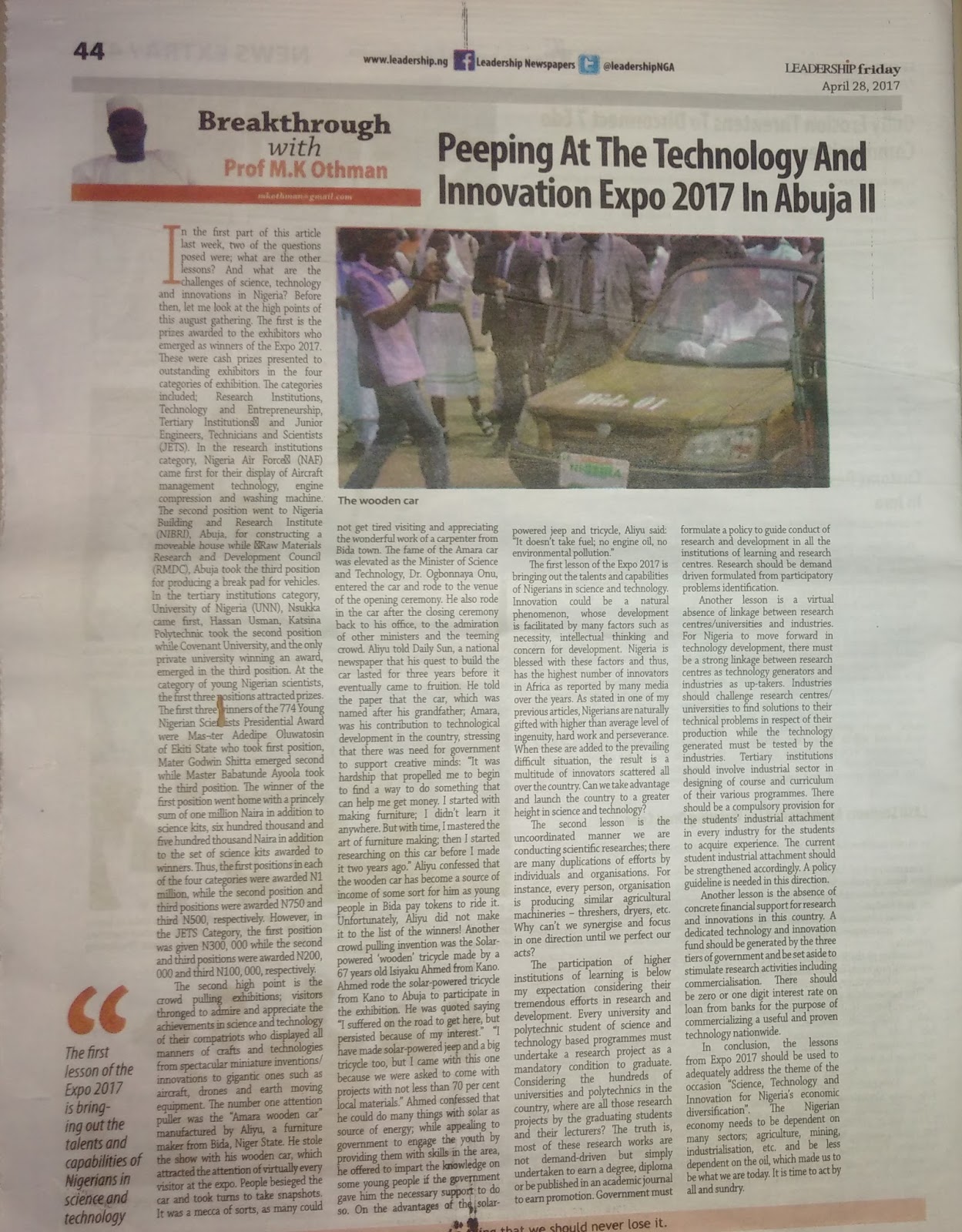
The second high point is the crowd pulling exhibitions; visitors thronged to admire and appreciate the achievements in science and technology of their compatriots who displayed all manners of crafts and technologies from spectacular miniature inventions/innovations to gigantic ones such as aircraft, drones and earth moving equipment. The number one attention puller was the “Amara wooden car” manufactured by Aliyu, a furniture maker from Bida, Niger State. He stole the show with his wooden car, which attracted the attention of virtually every visitor at the expo. People besieged the car and took turns to take snapshots. It was a mecca of sorts, as many could not get tired visiting and appreciating the wonderful work of a Carpenter from Bida town. The fame of the Amara car was elevated as the Minister Minister of Science and Technology, Dr. Ogbonnaya Onu, entered the car and rode to the venue of the opening ceremony. He also rode in the car after the closing ceremony back to his office, to the admiration of other ministers and the teeming crowd. Aliyu told Daily Sun, a national newspaper that his quest to build the car lasted for three years before it eventually came to fruition. He told the paper the car named after his grandfather; Amara, was his contribution to technological development in the country, stressing that there was need for government to support creative minds: “It was hardship that propelled me to begin to find a way to do something that can help me get money. I started with making furniture; I didn’t learn it anywhere. But with time, I mastered the art of furniture making; then I started researching on this car before I made it two years ago.” Aliyu confessed that the wooden car has become a source of income of some sort for him as young people in Bida pay tokens to ride it. Unfortunately, Aliyu did not make it to the list of the winners! Another crowd pulling was the Solar-powered ‘wooden’ tricycle made by a 67 years old Isiyaku Ahmed from Kano. Ahmed rode the solar-powered tricycle from Kano to Abuja to participate in the exhibition. He was quoted saying “I suffered on the road to get here, but persisted because of my interest quoted him. I have made solar-powered jeep and a big tricycle too, but I came with this one because we were asked to come with projects with not less than 70 per cent local materials.” Ahmed confessed could do many things with solar as source of energy; while appealing to government to engage the youth by providing them with skills in the area. He offered to impart the knowledge on some young people if the government gave him the necessary support to do so. On the advantages of the solar-powered jeep and tricycle, Aliyu said: “It doesn’t take fuel; no engine oil, no environmental pollution.”

The first lesson of the Expo 2017 is bringing out the talents and capabilities of Nigerians in science and technology.  Innovation could be a natural phenomenon, whose development is facilitated by many factors such as necessity, intellectual thinking and concern for development. Nigeria is blessed with these factors and thus, has the highest number of innovators in Africa as reported by many media over the years. As stated in one of my previous articles, Nigerians are naturally gifted with higher than average level of ingenuity, hard work and perseverance. When these are added to the prevailing difficult situation, the result is a multitude of innovators scattered all over the country. Can we take advantage and launch the country to a greater height in science and technology?
The second lesson is uncoordinated manner we are conducting scientific researches; there are many duplications of efforts by individuals and organizations. For instance, every person, organization is doing similar agricultural machineries – threshers, dryers, etc. Why can’t we synergize and focus in one direction until we perfect our acts?
The participation of higher institutions of learning is below my expectation considering their tremendous efforts in research and development. Every university and Polytechnic student of science and technology based programmes must undertake a research project as a mandatory condition to graduate. Considering the 100s of universities and polytechnics in the country, where are all those research projects by the graduating students and their lecturers? The truth is, most of these research works are not demand-driven but simply undertaken to earn a degree, diploma or publish in academic journal to earn promotion. Government must formulate a policy to guide conduct of research and development in all the institutions of learning and research centres. Research should be demand driven formulated from participatory problems identification.
Another lesson is a virtual absence of linkage between research centres/universities and industries. For Nigeria to move forward in technology development, there must be a strong linkage between research centres as technology generators and industries as up takers. Industries should challenge research centres/universities to find solutions to their technical problems in respect of their production while the technology generated must be tested by the industries. Tertiary institutions should involve industrial sector in designing of course and curriculum of their various programmes. There should be a compulsory provision for the students’ industrial attachment in every industry for the students to acquire experience. The current student industrial attachment should be strengthened accordingly. A policy guideline is needed in this direction.
Another lesson is the absence of concrete financial support for research and innovations in this country. A dedicated technology and innovation fund should be generated by the three tiers of government and be set aside to stimulate research activities including commercialization. There should be zero or one digit interest rate on loan from banks for the purpose of commercializing a useful and proven technology nationwide.

In conclusion, the lessons from Expo 2017 should be used to adequately address the theme of the occasion “Science, Technology and Innovation for Nigeria’s economic diversification”. The Nigeria’s economy need to be depended on many sectors; agriculture, mining, industrialization, etc and be less depended on the oil, which made us to be what we are today. It is time to act by all and sundry

Peeping at the Technology and Innovation Expo 2017 in Abuja

Peeping at the Technology and Innovation Expo 2017 in Abuja

In Nigeria, the clamor of Science, Technology and Innovation resonating our daily lives becomes a testimony of government seriousness to move the nation forward technologically. Last week, 12th April 2017, I presented a lecture titled “The impacts of Science, Technology and Innovation: Agricultural Extension” at National Institute for Policy Strategy Studies, Kuru before the participants of Senior Executive Course number 39. Other Lectures presented by distinguished scholars and important personalities at this prestigious Institute bore the magic words “Science, Technology and Innovation”. These are clear indication that government is unearthing the reasons for the nation backwardness in technological breakthroughs. In the same vein, the way forward for achieving technological advancement could as well be identified. This is why the famous “National Science and Technology Week (NASTECH)”, a statutory annual event was changed to Technology and Innovation Expo 2017” to be inline with government policy and direction for achieving milestone in science and technology. Right from inception in 1987, NASTECH was aimed at creating awareness in Science and Technology and showcasing achievements in the sector. Thus, the Expo 2017, in addition to awareness creation, it was designed to bring out achievements in science and technology, encourages indigenous innovations and technology, promotes Research and Development (R&D) as well as build partnership between Research institutions and investors. Specifically, The Expo has seven objectives as stated in the program:
1.      Promotion of Research and Development (R&D) activities;
2.    Commercialization of R&D results/inventions and innovations;
3.    Encouraging Nigerians to take up science professions;
4.    Showcasing to the public, potentials of R&D institutions;
5.    Building of partnerships between Researchers and Investors;
6.    Encouraging and promoting creation of innovative enterprises utilizing Nigeria’s indigenous knowledge and Technology to produce marketable goods and services;
7.    Promotion of R & D/ Industry Linkages as well as encouraging net workings amongst Researchers and Investors.
The 5 days event was held at the Eagles Square, Abuja between 3rd and 7th April 2017.  The Federal Ministry of Science and Technology (FMST) and the private sector were the organizers of the first innovation and technology Expo.

No doubt, the EXPO 2017 became a platform for solid foundation to build a vibrant economy; all-inclusive while Promoting Innovation and technology-led Industries. It is one of the strategic pillars of the Economic Recovery and Growth Plan 2017 – 2020, which was launched by His Excellency President Muhammadu Buhari on Wednesday 5th April 2017 at the State House, Abuja
The Expo served as an avenue to showcase recent developments in Research and Development efforts from the Federal Ministry of Science and Technology, it’s multiple Agencies, other MDAs, Higher Educational Institutions and Organized Private Sector. It also facilitated the interface with Development Partners while Exhibitors showcased their latest inventions/innovations thereby displaying their capabilities and potentials to attract collaborators and partners.
A wide variety of innovative products were on display at this gathering of who is who in Science and Technology in Nigeria. An estimated over 500 innovative products were displayed from the over one hundred exhibitors from Academia, research centres, industries and private individuals.
The exhibitions were outstanding and stupendous ranging from Unmanned Aerial Vehicle (aka Drone) made by the Nigeria Air Force; to the miniature “first in the world” wooden car made by a Furniture Maker with no formal technical education whose only motivation was inquisitiveness. The exhibitors cut across ages and educational strata ranging from Primary and Secondary school students who “likes to research things”; to Professors. An example was the SS2 Students from Regina Pacis School, Abuja who invented environmentally friendly, sustainable, fuel-free Magnetic generator and Dynamo Generator prototypes – with potential to address solve the perennial power-outage bedeviling the Nigerians nationwide. Similarly, there were innovative geniuses like Adedola and Abdulbaseet, SS1 Students of Anchor Sprigfield School, Ota, Ogun State who invented a GSM-controlled electronic circuit with capability to protect appliances from power surges and could allow the owner to switch off his or her electronic appliances at home from any location in respective of distance. This is quite unbelievable!
 The event was simply a success galore that made one of the organizers, Mohammed Attah the National Coordinator of the Civil Society Organization Coalition for Made-in-Nigeria products to react as reported by NewsDiary, an online newspaper, quoting him saying “There must be priority given to supporting the innovators and exhibitors by providing them with a visible online presence to attract investors and potential customers globally. In addition, future exhibitions should be massively publicized to get more international participants to patronize the innovators and exhibitors.”
The thinking of the Federal government on the Expo 2017 is reflected from the statement of Minister of Science and Technology, Dr. Ogbonnaya Onu who was quoted saying “the determination by the government to rebuild a Nigeria that all can be proud of cannot be actualized without deploying science and technology to move the country to a path of sufficiency and prosperity”. He further assured the participants that his ministry would not rest until science; technology and innovation become the driving force in Nigeria’s effort to diversify her economy in order to stimulate sustainable development. ThisDay, one of the Nigerian dailies quoted the minister saying “I commend the participants at this expo for showing the Nigerian spirit in them. Our hearts will never depart you because you are the future of Nigeria. We shall follow up on your inventions and mobilize the organized private sector to work together with you in the pursuit of the commercialization and your inventions. The challenge we face is to rebuild our nation and move her along the path of self-sufficiency, prosperity, and international respect. I am confident that we have taken the right steps in our journey to greatness. What is required is for us to build on our achievements so far and remain determined and focused in our collective desire to build a modern Nigeria where science, technology and innovation will be the engine for economic growth and development.“
The five days program ended on Friday, 7th April 2017 with prizes won by 12 individual participants and organizations. There were in four categories of prizes. The first category is the prize for Junior Engineers, Technicians and Scientists (JETS), the second for Technology Entrepreneurs, the third for Research Institutions and fourth for Tertiary Educational Institutions. The assessment team was generally impressed with the quality of works achieved in Science, Technology and Innovation (STI) sector in the country. It was stressed that, if these scientists, engineers and artists were nurtured and supported, they could resolve the challenges of over-dependence on imported products and services as well as infrastructural problems confronting the country. These challenges confronting the nation’s economy addressed by the exhibited projects crisscrossed all developmental sectors; food and agriculture; education; health; security and defense; ICT and social media; power and energy; transportation; housing; manufacturing; software development; elections; values and national re-orientation. Looking at the report of the assessment team led by the former Director-General of Raw Materials Research and Development Council (RMRDC), Engineer Prof. Peter Onwualu, showed that at least 165 individuals and organizations participated and exhibited no fewer than 578 projects at the event.
There are many lessons that could be learnt from the concluded Expo 2017. It was very clear from the event that a missing link between the prototypes developed by the “Engineers and Scientists” and the investors existed. Either, the developers should mass-produce their inventions or the investors should come on board to help mass produce such inventions. In each case, financial support is highly desirable. The Federal Government can play an active role by improving access to finance for these innovative entrepreneurs as well as provide fiscal incentives for private investment in Research and Development to catapult the massive potential of Made-in-Nigeria products to the global market. What are the other lessons? Who were the 12 prizewinners? And what are the challenges of science, technology and innovations in Nigeria? (To be continued next week)